

How EMDR Helps Heal Trauma
What is EMDR therapy?
EMDR stands for:
Eye Movement Desensitization and Reprocessing.
EMDR is an evidence-based trauma therapy originally developed by psychologist:
Francine Shapiro
It is widely used to help people process:
childhood trauma
PTSD
attachment wounds
anxiety
panic
grief
traumatic memories
and negative beliefs about self.
EMDR therapy focuses on helping the brain:
process and integrate unresolved traumatic experiences.
What EMDR Feels Like
EMDR is not hypnosis, and you remain aware and in control throughout the process.
We move at a pace that feels manageable for your nervous system. You do not need to share every detail of what happened for EMDR to be effective.
Sessions may include:
Identifying current triggers
Exploring memory networks
Building grounding and regulation tools
Reprocessing painful experiences
Strengthening healthier beliefs
Creating more calm and choice in the present
Many clients describe feeling:
lighter
less reactive
more clear
more connected to themselves
less stuck in old patterns
How trauma affects the brain
When overwhelming experiences happen, the brain may struggle to fully process the experience.
Normally, experiences move through adaptive memory networks and become integrated over time.
But trauma can overwhelm the nervous system.
When this happens, memories may become stored in a more fragmented or emotionally charged way.
Traumatic memories can remain connected to:
fear
shame
helplessness
panic
body sensations
survival responses
and negative beliefs.
This is why present-day triggers can sometimes feel:
emotionally bigger than the current situation.
The nervous system may react as though:
the danger is still happening now.
Understanding what happens in the brain during trauma recovery
Trauma does not only affect emotions.
It can also affect:
the nervous system
memory processing
emotional regulation
body sensations
attention
attachment
and the brain’s ability to accurately recognize safety in the present moment.
Many people living with trauma notice they logically know they are safe —
but emotionally and physically still feel:
activated
overwhelmed
frozen
hypervigilant
emotionally reactive
disconnected
or “stuck.”
This is because trauma is not stored only as a story.
Trauma can become stored in:
the nervous system
emotional memory networks
body sensations
beliefs about self
and survival responses.
EMDR therapy helps the brain reprocess traumatic experiences so they no longer feel emotionally or physiologically “stuck” in the present.
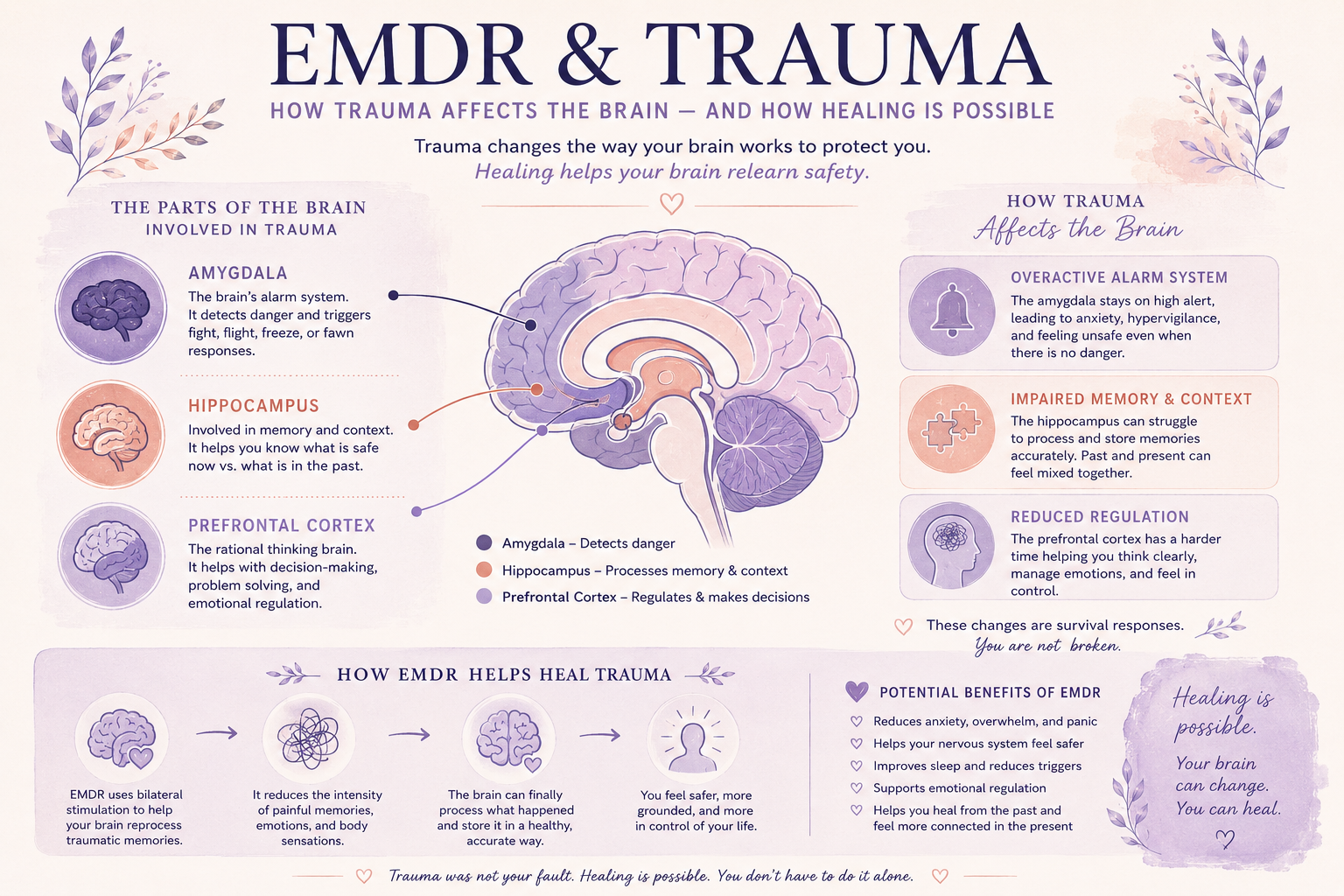
The amygdala, hippocampus, and prefrontal cortex
Trauma can affect several important brain systems involved in:
threat detection
emotional regulation
memory
and executive functioning.
The amygdala
The amygdala helps detect danger and activate survival responses.
In trauma survivors, the amygdala may become:
hyperactivated
highly sensitive to threat
or constantly scanning for danger.
This can contribute to:
hypervigilance
panic
emotional reactivity
and chronic anxiety.
The hippocampus
The hippocampus helps organize memories in time and context.
Traumatic memories are sometimes not fully integrated into normal autobiographical memory.
This can make traumatic experiences feel:
emotionally immediate
fragmented
or difficult to separate from present-day experiences.
The prefrontal cortex
The prefrontal cortex helps with:
reasoning
emotional regulation
impulse control
and recognizing present safety.
During trauma activation, the prefrontal cortex may become less active while survival systems become more dominant.
This is one reason people may intellectually know:
“I’m safe.”
while their nervous system still feels:
“I’m not safe.”
How EMDR helps the brain process trauma
EMDR therapy helps activate the brain’s natural processing system.
During EMDR, the client briefly activates traumatic memories while engaging in:
bilateral stimulation
eye movements
tapping
or alternating auditory stimulation.
This appears to help the brain:
reprocess traumatic material
reduce emotional intensity
integrate memory networks
and create new adaptive associations.
Over time, memories often become:
less emotionally overwhelming
less physiologically activating
and more integrated into normal memory.
Many people describe the memory as:
“feeling farther away.”
or:
“not controlling me anymore.”
EMDR and memory reconsolidation
Research suggests EMDR may involve:
memory reconsolidation.
Memory reconsolidation refers to the brain’s ability to:
update
reorganize
and re-store memories in a less distressing way.
Rather than erasing memories, EMDR helps the brain:
change how traumatic experiences are stored and connected.
This can reduce:
emotional flooding
panic
shame
intrusive reactions
and nervous system activation.
EMDR and nervous system healing
Trauma is often stored not only cognitively —
but physiologically.
Many trauma survivors live in chronic states of:
flight
or shutdown.
EMDR can help reduce chronic nervous system activation by helping unresolved survival responses finally process and complete.
Many people notice improvements in:
emotional regulation
anxiety
triggers
sleep
body tension
emotional reactivity
and sense of safety.
What research says about EMDR
EMDR is considered an evidence-based trauma therapy by organizations including:
the World Health Organization (WHO)
the American Psychological Association (APA)
the Department of Veterans Affairs
and the International Society for Traumatic Stress Studies (ISTSS).
Research has found EMDR can significantly reduce symptoms of:
PTSD
anxiety
traumatic stress
and emotional distress.
Research studies on EMDR
A randomized controlled trial by:
Bessel van der Kolk
and colleagues found that EMDR significantly reduced PTSD symptoms in trauma survivors, with many participants no longer meeting criteria for PTSD after treatment.
Neuroimaging studies have also shown changes in brain activation patterns following EMDR therapy, including reductions in hyperactivation in fear-processing areas of the brain.
Research suggests EMDR may help:
decrease amygdala overactivation
improve emotional regulation
support adaptive memory integration
and reduce physiological distress associated with traumatic memories.
EMDR is not about “forgetting”
People often worry EMDR will:
erase memories
force reliving
or make them lose control.
EMDR does not erase memories.
Instead, it helps the brain:
process experiences differently.
The memory remains —
but often loses its overwhelming emotional charge.
EMDR and emotional abuse
EMDR can be especially helpful for:
childhood emotional neglect
attachment trauma
and chronic invalidation.
Many people carrying relational trauma hold deeply rooted beliefs such as:
“I’m not safe.”
“I’m too much.”
“I’m not enough.”
“I can’t trust people.”
or “My needs don’t matter.”
EMDR helps target and reprocess the experiences that shaped these beliefs.
Healing is possible
Trauma responses are not signs of weakness.
They are signs that the nervous system adapted to survive difficult experiences.
EMDR helps the brain and nervous system recognize:
the trauma is no longer happening now.
FAQs
-
No. EMDR can help with single-event trauma, childhood wounds, repeated relational pain, anxiety patterns, and triggers that feel hard to explain.
-
No. You remain present and in control. We can pause anytime.
-
No. EMDR does not require sharing every detail.
-
Yes. EMDR can be adapted effectively for virtual therapy when appropriate.